

A resilient balance sheet is not determined by how much liquidity a bank holds. It is determined by how well Treasury knows when cash will arrive, when it will leave and how fast that picture can change.
For many community, regional and mid-size banks, forecasting still lives in the budgeting toolkit: a weekly spreadsheet built from business line estimates, which undersells it. Cash flow forecasting isn't about predicting the future. It's about understanding how today's balance sheet behaves when assumptions stop holding. In a stress event, that understanding often separates a difficult week from a liquidity crisis.
What supervisors already expect
- The interagency policy statement names cash flow projections first among the primary tools for managing liquidity risk and lists "a lack of meaningful cash flow projections" among the failings that recent stress events exposed.
- Projections should cover meaningful horizons, from day to day out to a year and beyond, under expected and adverse conditions, with intraday positions monitored alongside.
- Key assumptions should be reasonable, documented and formally approved, with deposit behavior assumptions reviewed against how customers have actually behaved.
- Contingency funding should be operationally ready: collateral positioned, borrowing lines tested and discount window access practiced.
Sources: Interagency Policy Statement on Funding and Liquidity Risk Management; OCC Comptroller's Handbook, Liquidity.
Why a reliable forecast is hard to build
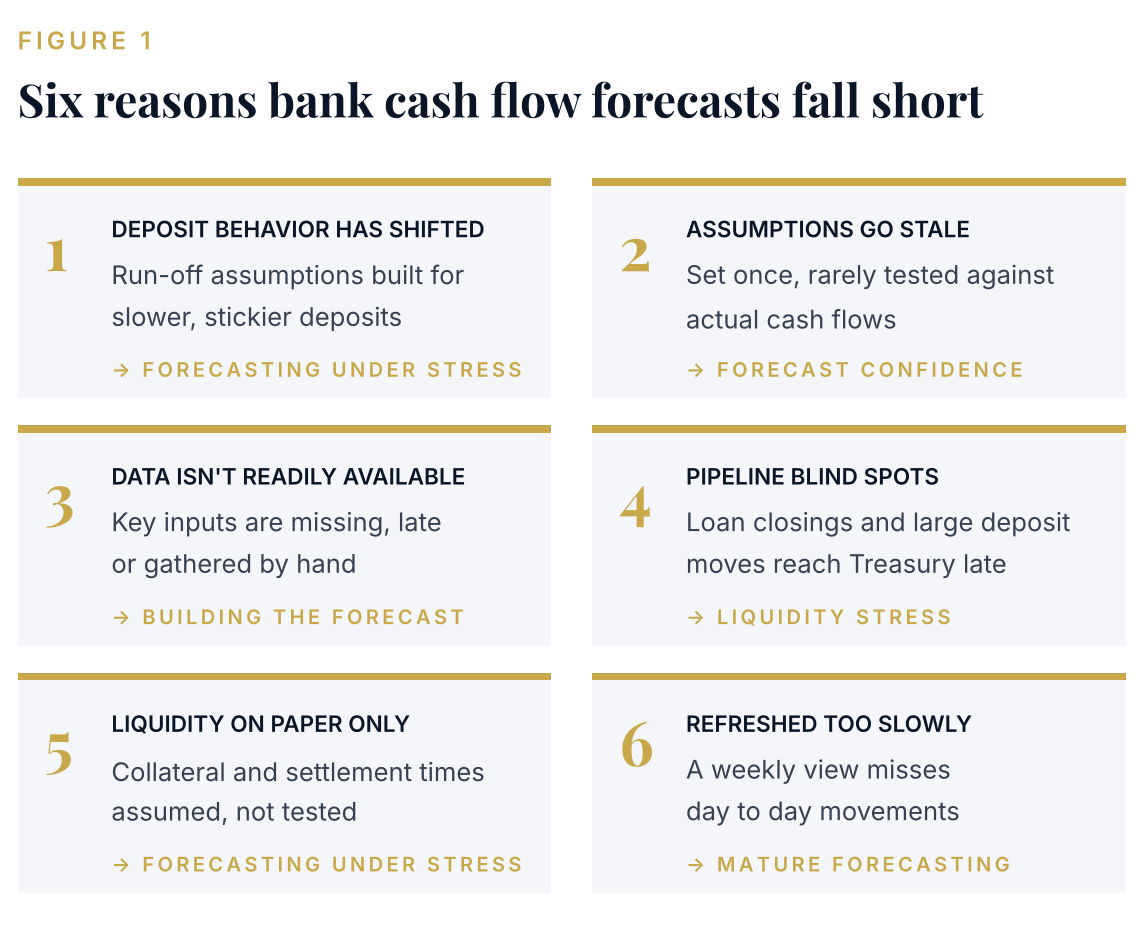
The reason to forecast better is not that examiners expect it. It is that the inputs behind most forecasts have weakened. Six shortcomings come up again and again. Each represents a different way forecasting can fail when liquidity is tested.
The first shortcoming makes the others more dangerous. In 2023 the agencies described the speed of deposit outflows at some banks as "unprecedented" and warned that depositor behavior can change "sometimes without warning." That is the real lesson of 2023: forecasting has become less about contractual cash flows and more about behavioral ones. A forecast built on last cycle's assumptions, from fragmented data, refreshed once a week, describes a balance sheet that no longer exists.
Behind most of these shortcomings sits a simpler problem: the data is not there when Treasury needs it. Deposit detail by segment, loan pipelines, unused commitments and collateral positions often sit in different systems, in spreadsheets or with individual staff, available only monthly or after manual extraction. A forecast can be no better than its inputs and many fall short before any assumption is made.
Liquidity stress usually begins as a forecasting failure
Liquidity crises rarely begin with a balance sheet that does not have liquidity. They begin with an unexpected cash flow and the inability to monetize that liquidity.
Most liquidity events do not start because the bank lacked liquidity. They start because Treasury misjudged timing: the resources existed, but in the wrong place, in the wrong form or a day too late.
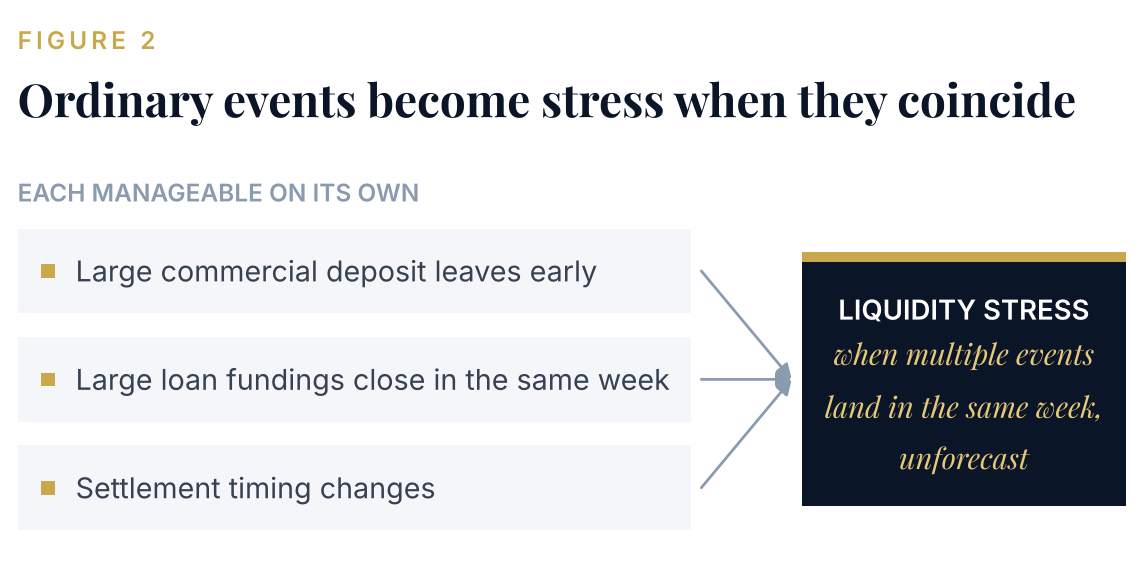
When multiple events land together against a forecast that assumed none of them, Treasury stops managing liquidity and starts discovering where it stands, with decisions made under pressure and at higher cost.
Forecasting sits at the center of Treasury
The forecast is not a standalone report. Almost every Treasury decision depends on it, so its errors spread across the balance sheet.
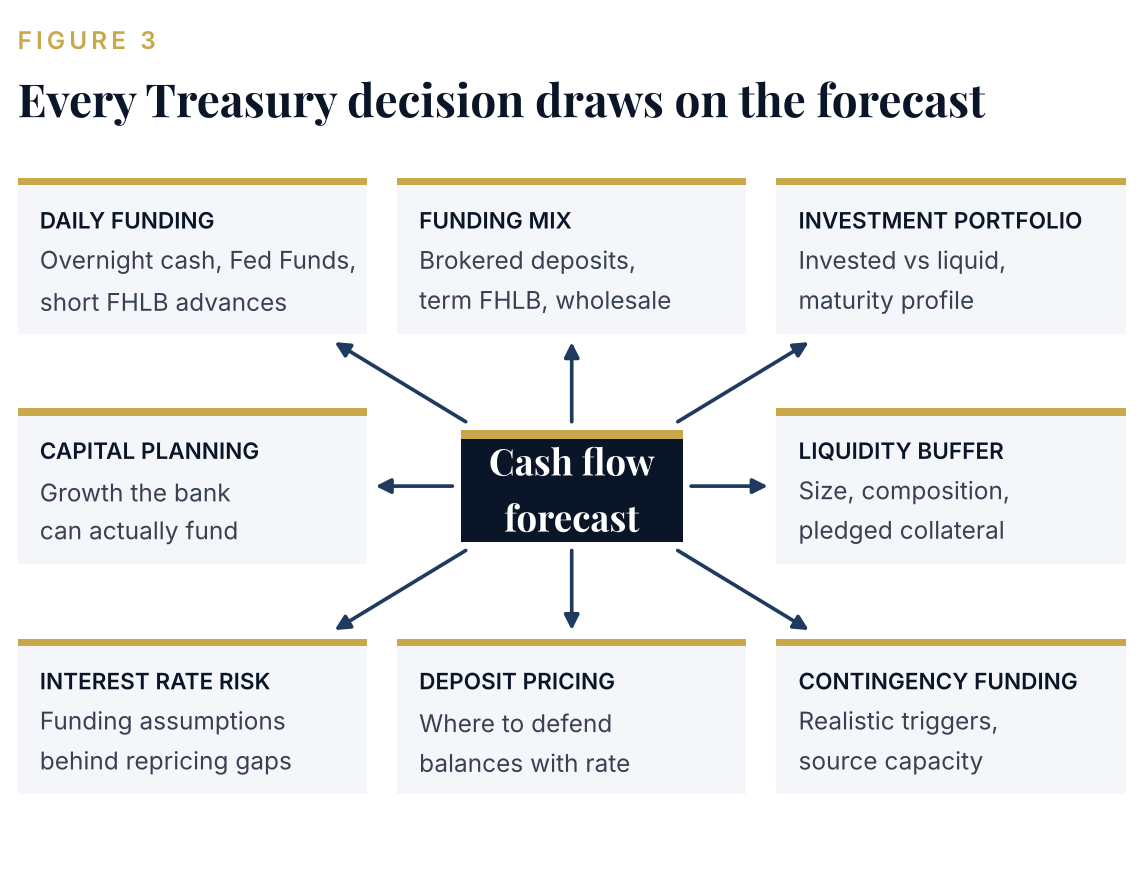
Every forecasting weakness gets paid for somewhere else on the balance sheet. A bank that cannot see its cash flows clearly either holds more liquidity than it needs and gives up margin or holds the right amount and relies on luck about timing.
Forecasting under stress
A forecast earns its value on the worst day, not the average one. A simple test for any Treasury team:
If 8% of uninsured deposits left tomorrow, could you answer these within hours?
- Cash position at the end of day one and day two
- Collateral available and how much is already pledged
- Borrowing capacity and how fast each source settles
- Securities unencumbered and ready to pledge or sell
- Intraday position, from your intraday monitoring
- Loan fundings committed this week and which can wait
- Payment obligations falling due and when
Most banks can answer each question eventually. The test is answering them together, quickly, with one view across Treasury, finance and operations.
From forecast accuracy to forecast confidence
No forecast is perfect, least of all under stress. The stronger capability is forecast confidence: knowing which lines are firm, where the uncertainty sits and how quickly the forecast can be refreshed. Confidence turns uncertainty from a surprise into something Treasury can size and manage.
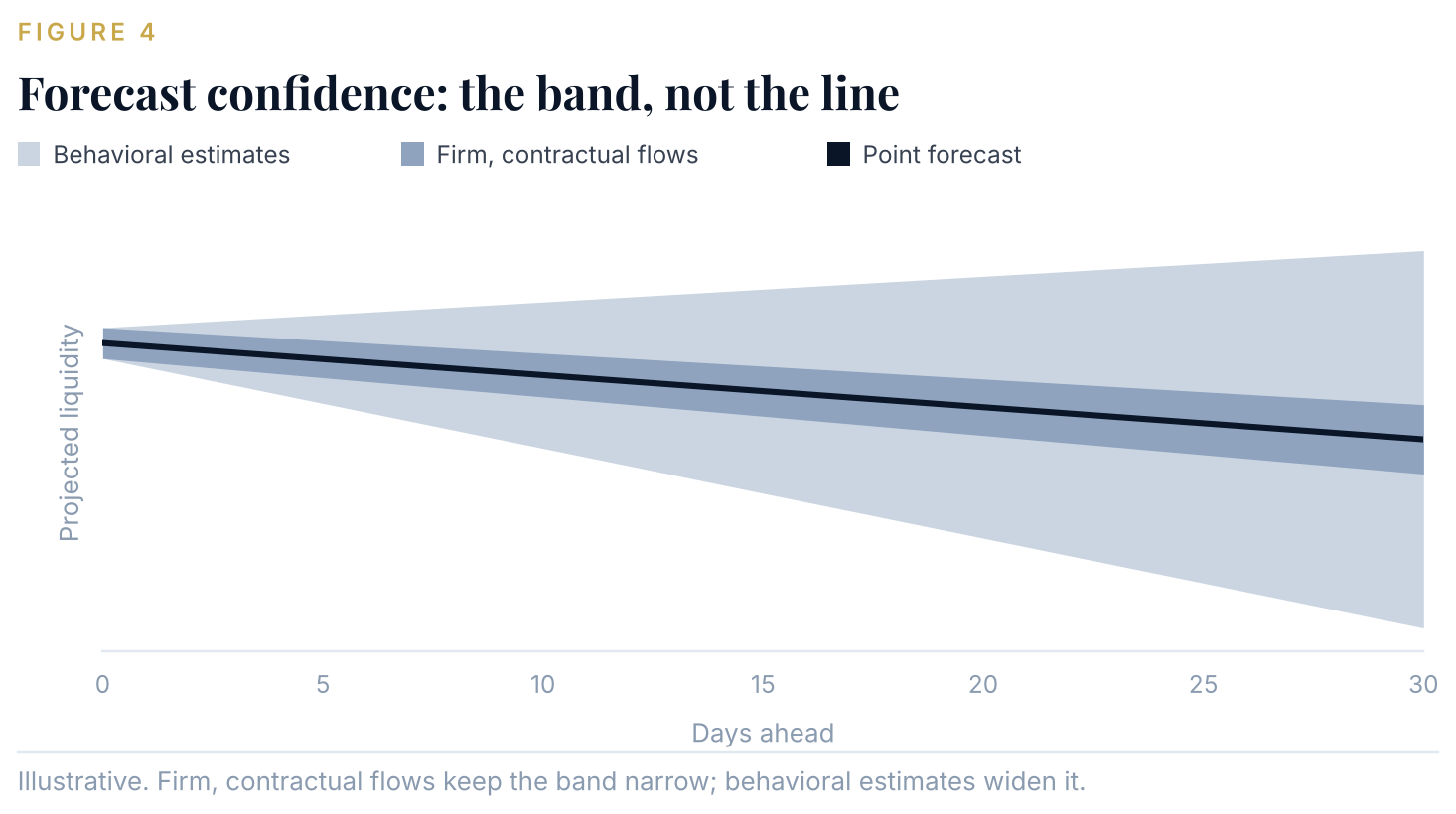
Variance tracking shows which assumptions repeatedly miss. A forecast that can be re-run in an hour with new deposit data is worth more in a stress event than a more precise one that takes three days.
What mature forecasting looks like
A robust cash flow forecasting model is about behavior, not software. Supervisors themselves note that projections can "range from simple spreadsheets to very detailed reports," depending on the bank's complexity. Modest systems can forecast well; sophisticated platforms can forecast poorly.
| Dimension | Basic | Advanced |
|---|---|---|
| Ownership | Business line estimates | Treasury owns it; business lines contribute |
| Refresh | Updated weekly or monthly | Updated daily |
| Horizon | Weekly or monthly buckets | Daily buckets to 30 days, then monthly to one year |
| Scenarios | Single base case | Base, adverse and severe in one model |
| Assumptions | Contractual flows, static run-offs | Behavioral, by deposit and commitment segment |
| Stress | Run separately from the forecast | Draws on the same data and assumptions as the forecast |
| Performance | Limited variance analysis | Accuracy tracked by line item |
| Confidence | A single number | Ranges, firm and estimated lines separated |
| Linkages | Standalone report | Feeds stress testing, the CFP and ALM |
| Data and systems | Pulled by hand into spreadsheets, monthly or less | Fed daily from bank systems, each input with an owner |
A note on intraday. The horizon above starts at the end of each day, by design. Intraday liquidity, how cash moves within the day as payments settle, is a separate discipline and most banks rightly monitor it separately. The forecast does not need to absorb it; it needs a clear hand-off, with day one positions shared with the intraday team and unusual intraday patterns fed back as early warnings. We cover intraday liquidity in more depth in Intraday Liquidity: From Payment Operations to Strategic Balance Sheet Management.
Building the forecast: a practical roadmap
Supervisors do not prescribe a model, but their expectations add up to a clear sequence. The interagency policy statement was written to align with the Basel Committee's Principles for Sound Liquidity Risk Management and Supervision, so the same steps also reflect international practice.
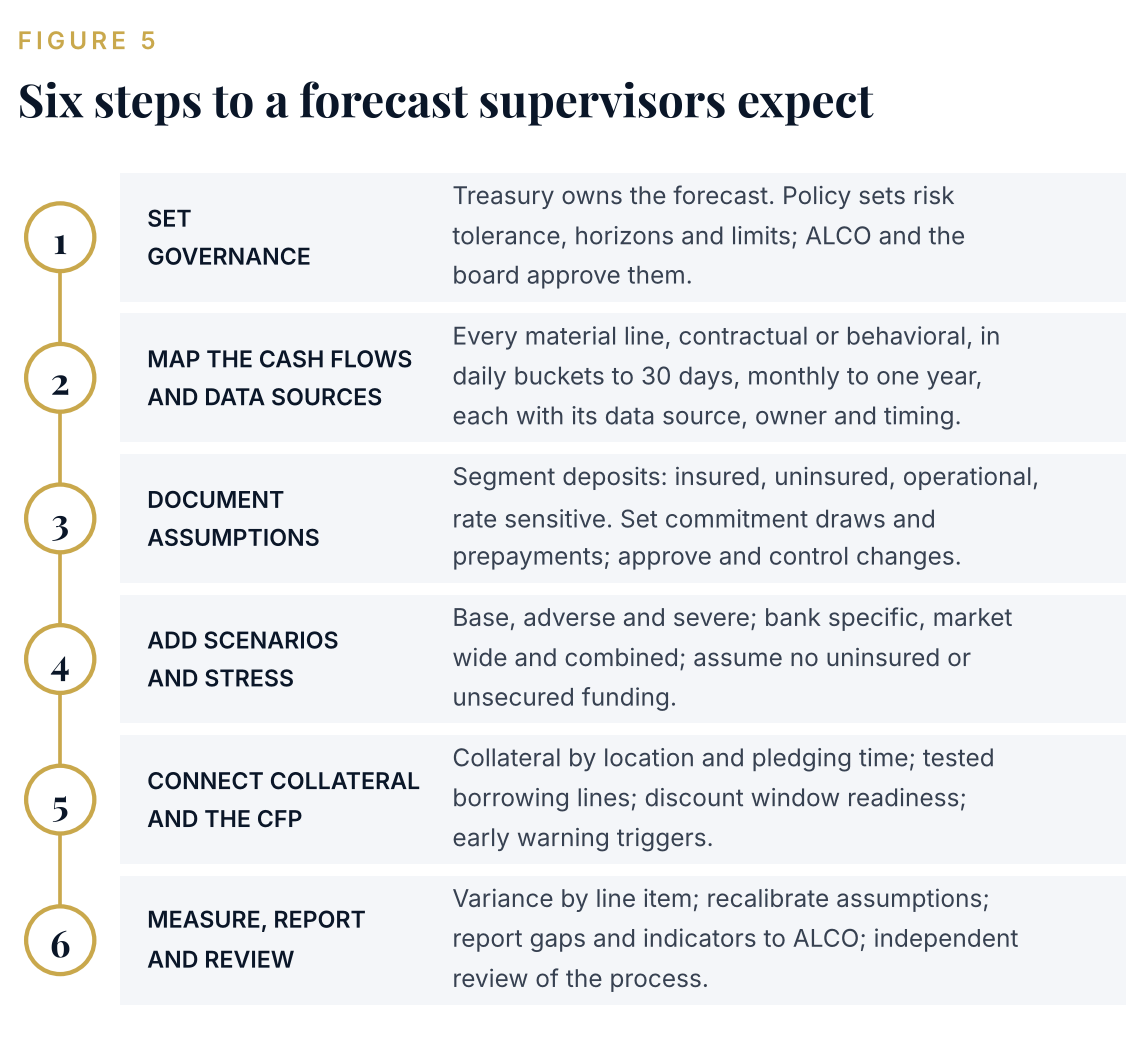
Supervisors assess forecasting through governance, assumptions and evidence. Treasury should see the same framework as a sequence for improving decisions.
What examiners will look for at each step
| Step | What supervisors expect | Evidence to have ready |
|---|---|---|
| 1. Governance | Board approved liquidity risk tolerance, policies and limits, reviewed at least annually | Liquidity policy, ALCO and board minutes, limit reports |
| 2. Cash flow map | Projections of assets, liabilities and off-balance sheet items over defined horizons, in expected and adverse conditions | Cash flow gap report by time bucket; data source inventory, with gaps and owners |
| 3. Assumptions | Reasonable, documented and formally approved; deposit stability tested against historical behavior and changes in customer mix | Assumption register with owners, approval dates and a change log |
| 4. Scenarios and stress | Regular bank specific and market wide stress tests across horizons, shaping the CFP | Stress results and the management actions they led to |
| 5. Collateral and CFP | Collateral positions calculated in a timely way; contingency sources operationally ready and tested | Collateral report, pledging procedures, test borrowing records |
| 6. Reporting and review | Reporting of gaps, critical assumptions and early warning indicators; independent review of the process | ALCO pack, back-testing results, independent review findings |
Few banks need to do everything at once. The best first steps are usually Treasury ownership (step 1), mapping where each input comes from (step 2), a documented assumption register (step 3) and variance tracking (step 6), followed by running stress scenarios from the forecast's own data (step 4). Each improves decisions without a technology project and together they answer most of what an examiner will ask.
Capital, liquidity, interest rate risk and visibility
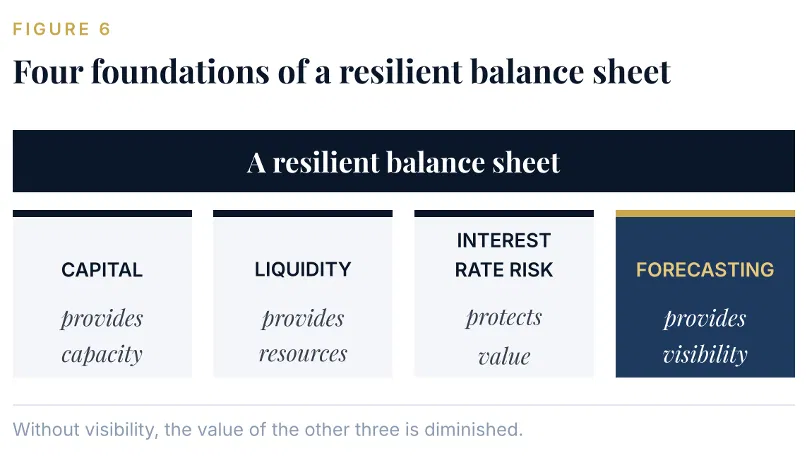
The 2023 banking crisis showed how closely these are connected. Rising rates left securities portfolios carrying large unrealized losses, so liquidity that looked available could not be monetized without eroding capital. When deposits then moved faster than expected, capital, liquidity and interest rate risk came under pressure at the same time.
A bank can be well capitalized, hold ample liquidity and manage its rate exposure, yet still come under pressure because it did not see the timing of its own cash flows soon enough.
Our Perspective
Since 2008 the industry has invested heavily in measuring liquidity: ratios, buffers, stress tests and contingency plans. Those are real improvements and they remain the right foundation. But they mostly answer how much liquidity a bank holds. The events of 2023 showed that the harder question is when cash will move, and whether Treasury will see it coming.
For most community and regional banks, answering that question does not require a new platform or a transformation program. It requires Treasury to own the forecast, know where each input comes from, test assumptions against how customers actually behave and be honest about how confident the forecast is. Most of the data already exists somewhere in the bank; the work is getting it to Treasury in time to matter.
The return comes twice: once in resilience, and again in better funding, pricing, investment and capital decisions built on the same forecast. Banks that skip the work will keep holding buffers sized for uncertainty they have never measured and paying for it in margin, until the week the buffer is not enough.
The objective isn't a more accurate forecast. It's a balance sheet whose behavior Treasury already understands before stress arrives. Resilient balance sheets aren't built by holding more liquidity; they're built by reducing uncertainty before liquidity is needed.
Treasury succeeds when uncertainty becomes visible before it becomes expensive.
Prepared November 2026. General information, not legal, regulatory or investment advice. Regulatory citations should be verified against current issuances before being relied upon for a specific decision.