

Most banks measure liquidity once a day. Supervisors increasingly expect them to understand it at least by the hour.
That gap is not a reporting problem. It is a risk-management problem and three things have widened it since 2023: payment rails that clear in seconds, a depositor base that acts on the same information at the same moment and Treasury operations still running on a daily cycle.
For community, regional and mid-size banks the question is not whether the Basel intraday monitoring tools formally apply. For most of them, they do not. The question is whether management can say how much liquidity the bank actually needs at 10:00 a.m., where it comes from and how fast it can be mobilised if the usual source is unavailable.
Intraday liquidity has moved from payment operations to the ALCO agenda. This article sets out why and what a proportionate framework looks like for a bank that is not a GSIB.
Stress Now Moves in Hours, Not Days
The 2023 failures are usually discussed as a story about unrealised securities losses and uninsured deposit concentration. Both are true and both were slow-moving conditions that existed for months. What killed those banks was speed. Silicon Valley Bank faced roughly $42 billion of withdrawal requests on 9 March 2023, about a quarter of its deposit base in a single business day, with a further $100 billion expected the following morning.1
SVB is a contingency funding story rather than an intraday one. What it changed is the unit of time. A funding problem once measured in days is now measured in hours and hours is the domain of intraday liquidity. Three structural changes have made that tempo normal.
Payments now clear continuously. FedNow and RTP settle in seconds around the clock and Fedwire carries the large-value flows that matter most to a mid-size bank. A deposit that once took a business day to leave can now leave in under a minute at 2:00 a.m. on a Sunday.
Depositors act on the same information at the same moment. The Federal Reserve's review of SVB described a depositor base whose withdrawal requests accelerated faster than the bank could respond.1 Information about a bank's condition, accurate or not, now reaches its largest depositors simultaneously rather than sequentially.
Treasury operations have not changed at the same rate. Most banks still produce a daily cash position in the morning, reconcile it at the close and forecast liquidity monthly. The measurement system runs on a slower clock than the risk it measures.
A framework that tells the board where the bank stood at 16:00 is describing a moment that no longer determines survival.
What Intraday Liquidity Actually Is
The textbook definition, "the ability to make payments when due", is accurate and almost useless for management purposes, because it describes an outcome rather than a capability. We define it this way:
Three horizons are routinely conflated and they are not the same question.
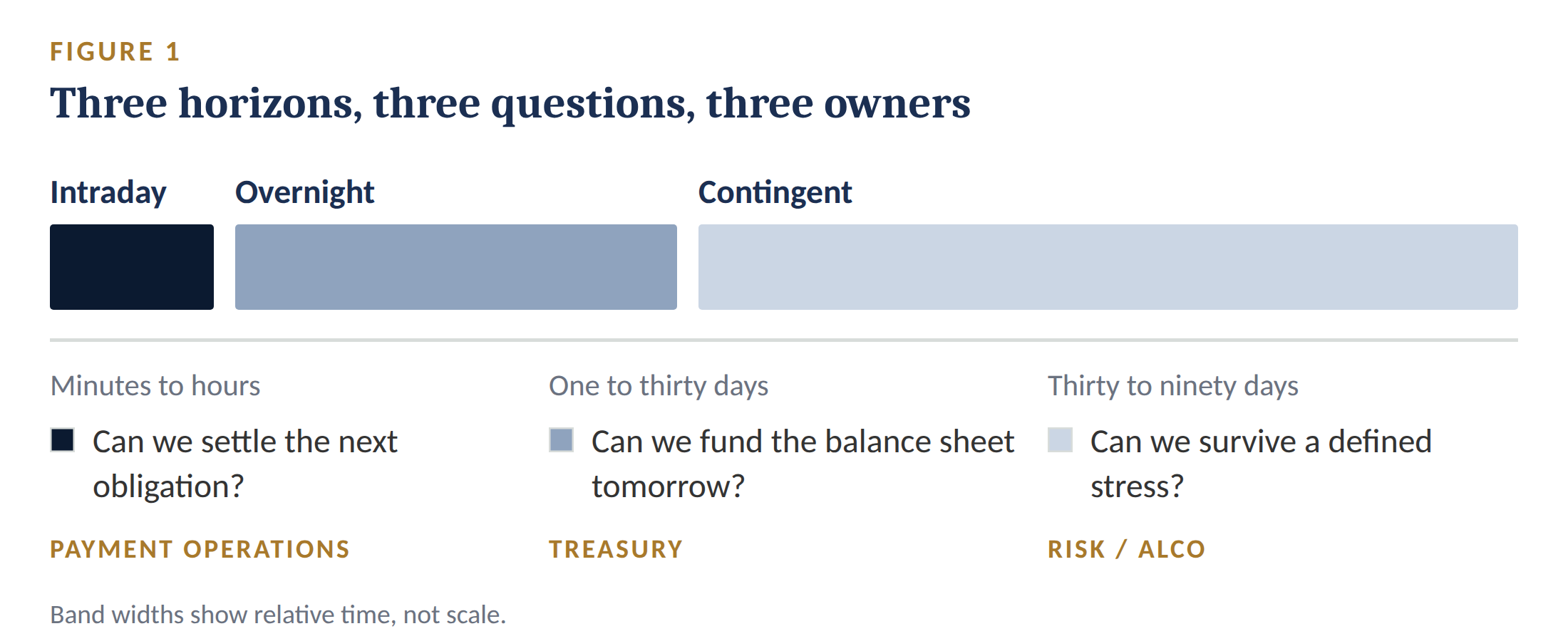
Intraday, overnight and contingent liquidity answer different questions and in most banks they are owned in three different places.
Why End-of-Day Metrics Miss It
Every liquidity measure a bank maintains has the same blind spot. Each one measures a quantity of liquidity. None measures its timing.
The LCR compares a stock of high-quality liquid assets against thirty days of modelled net outflow. It is a horizon measure. It says nothing about whether the bank can settle at 10:15 a.m.
Liquidity stress testing runs on end-of-day data. Where intraday exposure is captured at all, it is usually a calibrated add-on based on a historical high-water mark. That describes the largest intraday requirement the bank has already seen, not the one a new stress would create.
Cash forecasting produces an opening position and a projected close. The path between them is where the bank either settles its obligations or does not.
Contingency funding plans identify sources and sequence them. Most are written in terms of amounts available rather than time to availability and the difference between those two is where intraday risk lives.
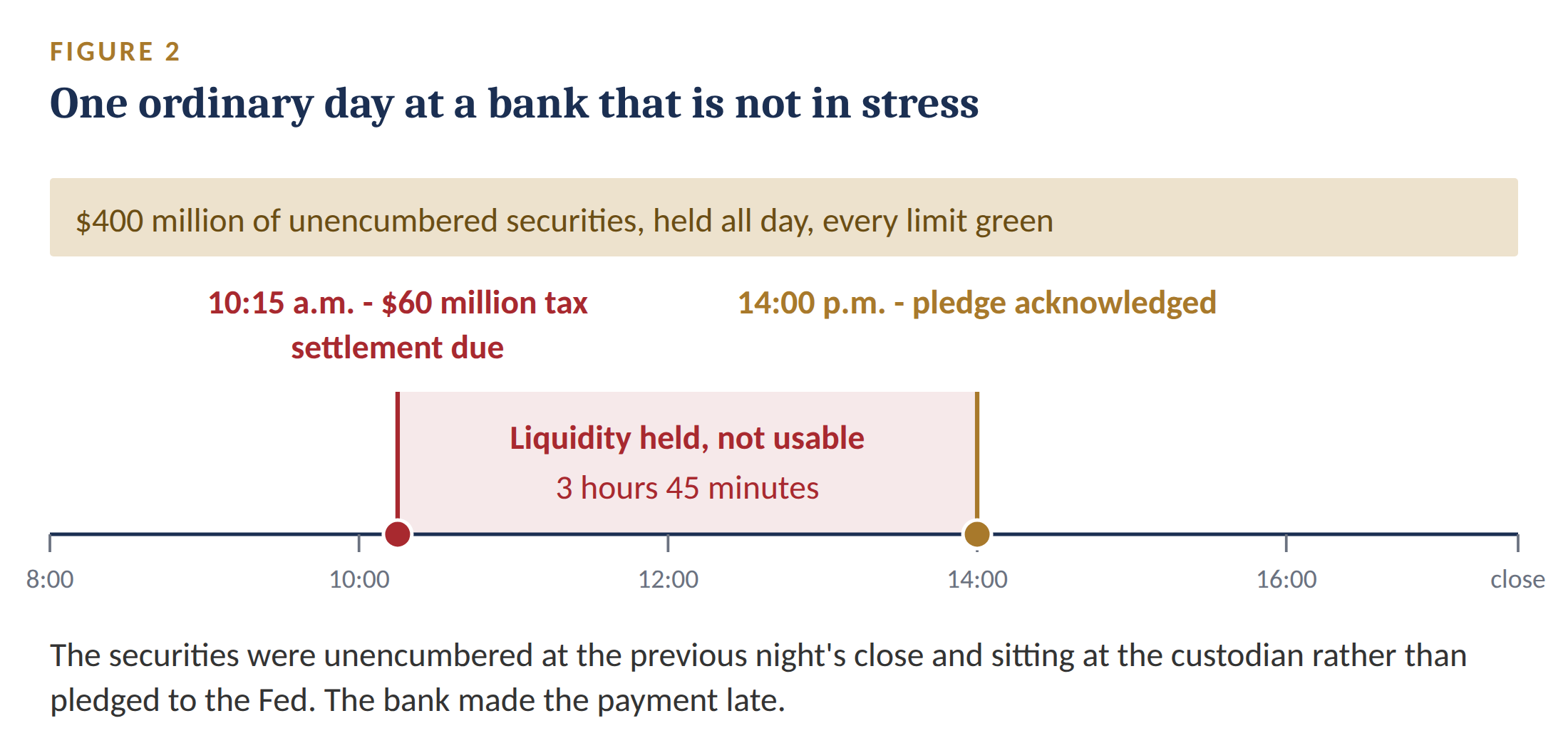
Liquidity the bank held all day, in a form it could not use at the moment it was needed.
That is intraday liquidity risk and not a shortage of liquidity. It is a mismatch between when liquidity is needed and when it becomes usable.
Intraday Liquidity Is Balance Sheet Risk
Intraday liquidity is not a self-contained operational discipline. It is a constraint that runs through every major balance sheet decision.
Funding
Every wholesale funding source has a time signature as well as a price.
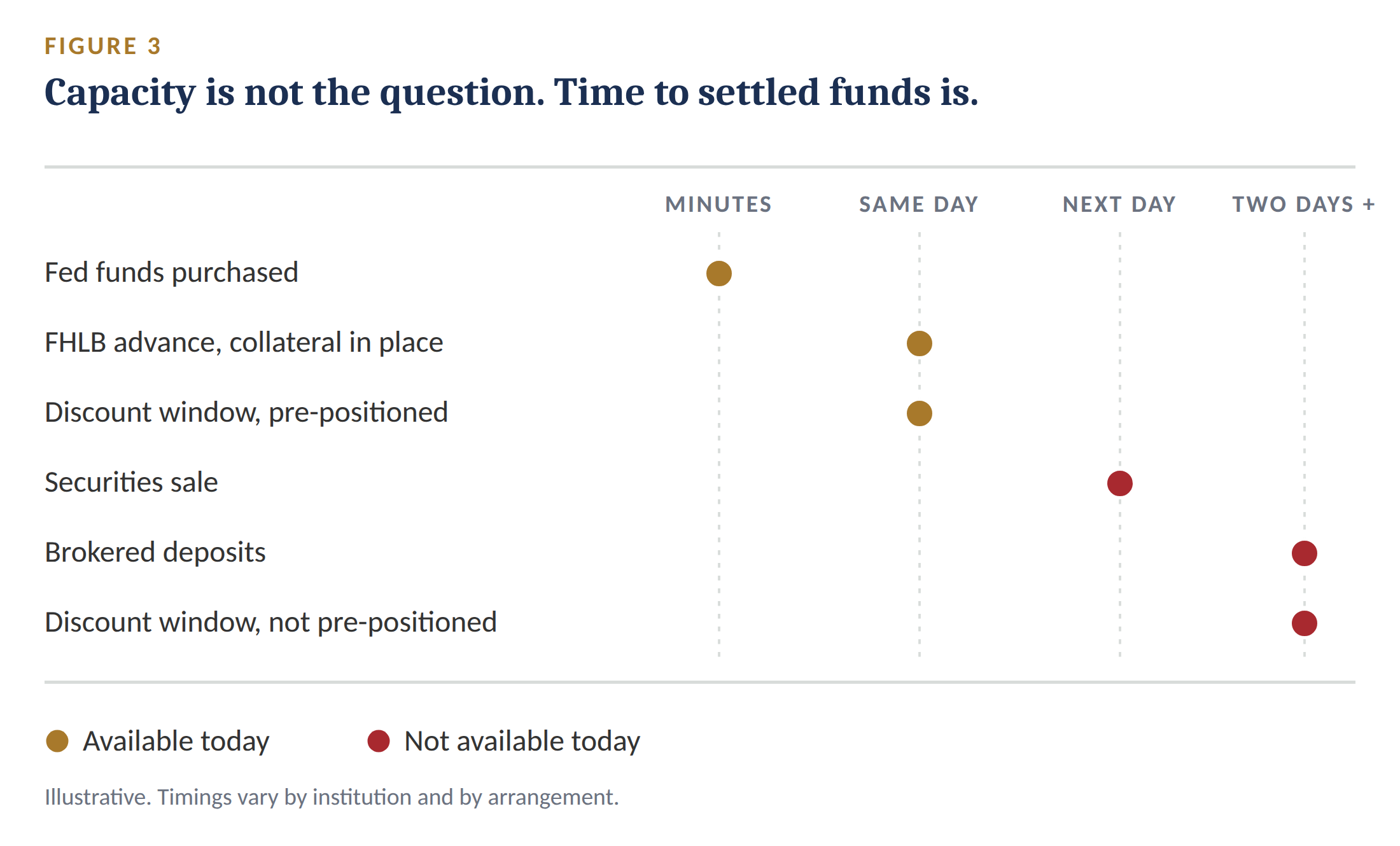
The sources a bank counts on most are often the ones that arrive last.
A funding inventory should record, for each source, the amount available, the collateral required, the request cutoff and the elapsed time from decision to settled funds. Most banks have the first two. The last two are where intraday risk is priced.
Deposits
Deposit concentration is normally analysed by balance. Intraday risk is driven by the timing of movement, which is a different distribution.
A bank with $300 million in commercial operating accounts may see $80 million leave in a two-hour window on payday. Nothing is wrong. That is what its customers do twice a month and it sets the baseline intraday requirement before any stress at all.
A bank that has mapped its deposit base by payment behaviour knows its peak hour. A bank that has mapped it by balance and rate alone does not.
Securities and Collateral
The relevant question about the securities portfolio is not how much of it is unencumbered. It is how quickly an unencumbered position becomes usable.
Selling settles on a cycle. Pledging requires an acknowledgement. Moving collateral between a custodian, the FHLB and the Federal Reserve takes operational steps with their own cutoffs. A portfolio that is fully unencumbered and entirely unpositioned will not help before tomorrow.
Pre-positioning is therefore not operational housekeeping. It is a decision about how much of the bank's liquidity is available in hours rather than days and it belongs at ALCO.
Loan Growth
Growth consumes intraday capacity in ways that rarely appear in the growth plan. Construction loan draws are unpredictable in timing and lumpy in size. A commercial book with large revolvers creates a contingent claim exercisable at any point in the business day. Growth in commercial operating relationships, the deposits every bank wants, brings payment volume and payment concentration with it.
The question for ALCO is whether Treasury can support the lending plan without creating payment bottlenecks and whether anyone has asked.
Capital
A bank that cannot settle on time pays for liquidity at the wrong moment and at the wrong price. Emergency funding compresses margin and compressed margin eventually reaches capital. More immediately, a failed time-critical payment damages something harder to rebuild than a basis point of margin. Correspondents, large depositors and rating agencies all form views on operational competence and none of them waits for a CAMELS rating.
From Control to Capability
Most treatments of intraday liquidity stop at control: monitor the position, avoid a settlement failure, satisfy the examiner. That is the floor and it is where almost every bank below the GSIB threshold stops.
The ceiling is different. Payment flow data is the most granular behavioural information Treasury holds about its own customers. It records what they actually did, hour by hour, rather than what a model assumes they might do. A bank that builds the capability to see its intraday position acquires, as a by-product, a dataset that improves four decisions it was already making on thinner evidence.
Deposit segmentation that reflects behaviour. Payment activity distinguishes an operating account from a rate-seeking balance far more reliably than product type or size. Two $20 million relationships in the same product can behave nothing alike and the balance sheet cannot tell them apart. Payment data can. That distinction drives beta and decay assumptions, so the work pays into IRR measurement and deposit pricing rather than sitting in a liquidity file. We set out the economics of that in Build to Your Balance Sheet, Not to the Supervisory Cycle.
Buffer sizing on evidence. A bank that knows its actual peak intraday requirement and the distribution around it can size its operational buffer deliberately. A bank that does not will hold too much, which is an invisible and permanent drag on margin, or too little, which it discovers once. The buffer most banks carry was set by judgement years ago and has never been tested against what the bank actually used.
Collateral optimisation. Knowing which obligations are genuinely time-critical and when tells Treasury how much collateral needs to sit pre-positioned at the Fed, how much pledged at the FHLB and how much held unencumbered for sale. Those three allocations carry materially different costs and in most banks the split is set by habit rather than by requirement.
Correspondent negotiation. A bank that can demonstrate its own payment patterns, peak usage and volatility negotiates intraday credit from a position of evidence. A bank that cannot is accepting terms set by the correspondent's assumptions about banks of its size.
Most banks already generate the necessary data. The opportunity is to ask different questions of it.
| Dimension | Typical industry view | The view we would take |
|---|---|---|
| Regulatory | Meet payment obligations | Demonstrate control under supervisory review |
| Risk | Avoid settlement failures | Protect funding resilience and counterparty confidence |
| Strategic | A Treasury operations function | Evidence that improves pricing, collateral allocation and growth decisions |
What Supervisors Expect
The formal bar is low and most banks are not clearing it. Reporting requirements reach only the largest banks. The expectation that management understands its own payment obligations reaches everyone.
Basel
Principle 8 of the Basel liquidity principles requires a bank to actively manage its intraday positions so that it can meet payment and settlement obligations on time under both normal and stressed conditions.2 Six operational expectations follow and the first is the one most often skipped: identify and prioritise time-specific obligations. A bank that has not done that cannot do the other five.
The monitoring tools in BCBS 248 were built for internationally active banks as reporting instruments rather than prudential requirements.3 A community bank is not expected to report that tool set. It is expected to answer the questions those tools were built to answer.
United States
US guidance places intraday liquidity inside the broader funding and liquidity risk framework rather than in a regime of its own. The Interagency Policy Statement on Funding and Liquidity Risk Management expects banks with material payment, settlement and clearing activity to monitor and manage intraday positions as part of overall liquidity risk management.4 The Federal Reserve's Payment System Risk policy governs daylight overdrafts directly through net debit caps, collateralised capacity and pricing for uncollateralised usage.5
Examiners at a mid-size bank ask a consistent set of questions: what are the bank's largest and most time-critical payment obligations, how does it fund them, what happens if the usual source is unavailable and who is authorised to act when it is.
Community and Smaller Regional Banks
This is where proportionality is most often misread as exemption. No supervisor expects a $3 billion bank to run the intraday infrastructure of a clearing bank. The same supervisor expects management to understand its payment dependencies and much of that risk sits where the balance sheet cannot show it:
- Correspondent relationships. A bank that clears through a correspondent inherits that correspondent's cutoffs, intraday credit decisions and risk appetite. The correspondent can reduce intraday credit without notice and is most likely to do so when the bank needs it.
- Federal Reserve account usage. A bank holding a master account needs to know its net debit cap, how close it runs to it and whether its daylight overdraft capacity is collateralised.
- Same-day access. Every rail has a cutoff. FHLB advances need collateral already in place and a request inside the same-day window. Discount window capacity needs collateral pre-positioned days ahead. A source that arrives tomorrow is not intraday liquidity today, whatever the unencumbered asset balance says.
The 2023 regional banking crisis made the last of these concrete. Several banks discovered under stress that capacity they believed was there was not yet operationally established.
Governance
Intraday liquidity fails in banks not because nobody watches the position, but because the person watching it has no route to anyone who can act.
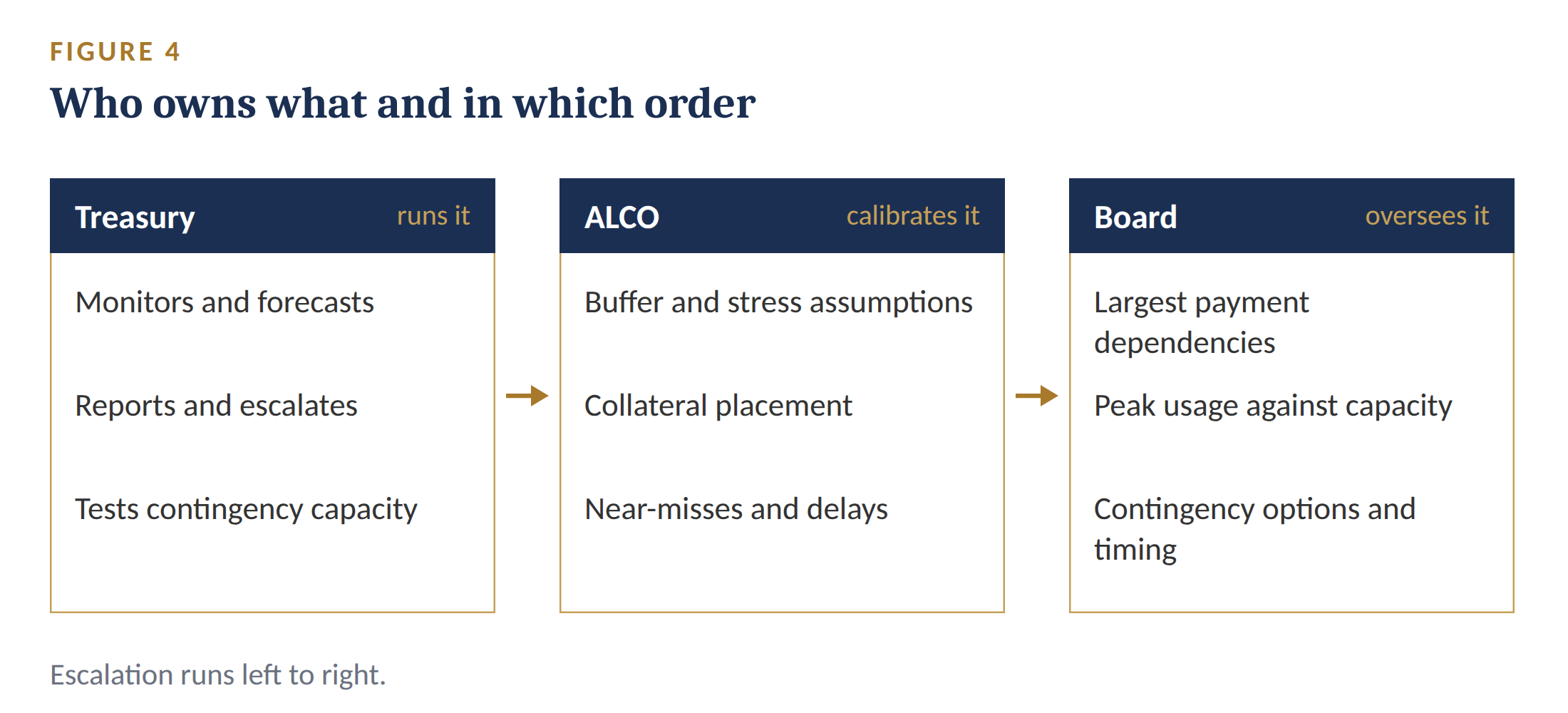
Treasury versus Operations. The most common structural fault is that the function which sees the position is not the function that can change it. Operations sees the payment queue and the Fedwire cutoff in real time. Treasury holds the funding authority and the collateral relationships. Where the two sit in different reporting lines with no shared metric, each performs its own role correctly and the risk falls between them. Where the boxes sit matters less than whether one named function owns the number.
Escalation and prioritisation. Most banks have a policy describing who should be informed. Fewer have one describing who may decide. The second is what the bank needs at 11:00 a.m. and it should be walked through before the day it is needed.
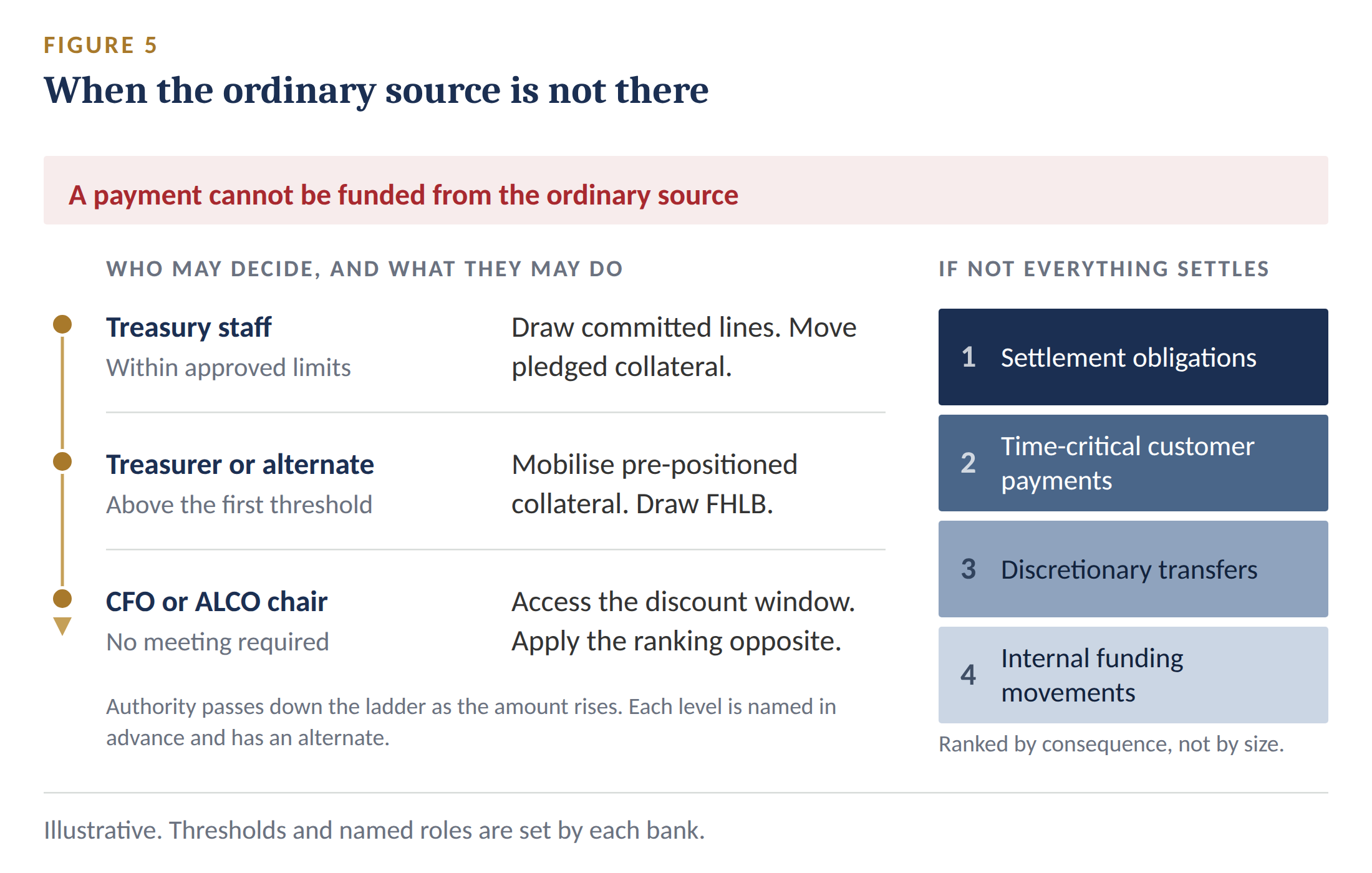
Writing the ranking matters more than holding the document, because it forces the bank to identify which of its payments actually carry a deadline. That is the question Basel Principle 8 asks first.
ALCO reporting frequency. Cadence should follow proximity to constraint rather than the calendar.
| When | What ALCO should see |
|---|---|
| Peak usage sits comfortably below the buffer | Monthly. Peak usage trend and the drivers behind any change |
| Peak usage approaches policy | Every meeting. Buffer headroom and the plan to restore it |
| A correspondent changes terms | At the next meeting. Revised intraday capacity and what it costs |
| Any near-miss or settlement delay | At the next meeting. Root cause and what was changed |
The item most often missing from the pack is the near-miss itself, a settlement that nearly failed and the reason it did not. It is the most informative thing on the agenda and it rarely appears because nothing went wrong.
Board education. The board does not need intraday metrics. It needs enough understanding to ask whether the bank's liquidity is available when it is needed, which is not a question most directors have been given the vocabulary for. A short annual session is usually sufficient: how the bank settles, who clears for it, what its intraday dependencies are and what happens when the correspondent reduces its line. If the board cannot describe what the bank would do on that morning, it does not have the information it needs.
Testing is the item that separates a framework from a document. Contingency capacity that has never been drawn is capacity that has been assumed rather than confirmed.
What Good Looks Like
Maturity is a more useful frame than compliance, because it tells a bank where it actually is rather than whether it has cleared a bar.
Level 1: Operational. Treasury monitors the Federal Reserve or correspondent account balance during the day and reacts to shortfalls. The bank can tell you what happened; it cannot tell you what will happen. Most community banks sit here.
Level 2: Risk-aware. The bank forecasts its intraday path rather than its closing position, tracks collateral by location and time to mobilise, identifies time-critical obligations explicitly and stress-tests the intraday profile. The bank can answer a supervisor's questions from its own records.
Level 3: Strategic. Intraday data feeds balance sheet decisions. Buffer sizing is evidence-based, payment behaviour informs deposit segmentation and pricing, and growth plans are tested against intraday capacity before they are approved.
The distance from Level 1 to Level 2 is mostly effort and attention. The distance from Level 2 to Level 3 is a decision about whether the bank treats the work as a cost or as an asset.
The difference is easier to see in two banks of the same size, running the same LCR and reporting a similar unencumbered securities balance.
| Community Bank A | Community Bank B | |
|---|---|---|
| Intraday position | Fed account checked twice a day | Hourly payment forecast against the day's obligations |
| Payment profile | No payment forecast. Peak requirement unknown | Largest payment windows identified and sized |
| Collateral | FHLB collateral pledged after the funding decision | Collateral pre-positioned at the Fed and the FHLB before it is needed |
| Contingency | Same-day capacity assumed | Daylight funding tested, with the result recorded |
| Position | Can say what happened | Can say what is about to happen |
Bank B is not more liquid than Bank A. It holds the same assets and the same buffer. The difference is that Bank B knows when its liquidity becomes usable and Bank A will find out on the morning it matters.
Metrics That Earn Their Place
The measurement literature on this subject is large and most of it is unnecessary for a bank below the GSIB threshold. A proportionate set:
| Daily, to Treasury | Monthly, to ALCO | Periodically, to the board |
|---|---|---|
| Peak intraday liquidity usage and the time it occurred | Peak usage trend and the drivers behind any change | Intraday buffer against policy and against observed peak |
| Largest net funding gap within the day | Collateral pre-positioned by location, with time to mobilise | Largest payment dependencies and concentration |
| Available intraday liquidity at the point of peak usage | Payment flow concentration by counterparty and by hour | Stress-day intraday funding requirement |
| Daylight overdraft usage against net debit cap | Unused borrowing capacity that is genuinely same-day accessible | Results of contingency testing, including what was actually drawn |
| Time-specific obligations met and any missed or delayed | Settlement delays and near-misses, with root cause |
The board list is short deliberately. Five items a director can interrogate are worth more than thirty a director will skim.
Our Perspective
The industry spent more than a decade after the 2008 financial crisis strengthening end-of-day liquidity. The metrics, the stress testing and the contingency planning built in that period are genuine improvements and they remain the right foundation. But they were designed for a world in which a deposit took a day to leave and a run took a week to develop. That world ended somewhere around March 2023.
The next stage is understanding what happens before the day ends. For most community and regional banks that does not require new systems or a dedicated team. It requires Treasury to ask a different question of data the bank already produces: not how much liquidity we hold, but when it becomes usable and whether that is soon enough.
The banks that do this will find the work pays twice, once in resilience and once in the quality of the funding, pricing and collateral decisions the same data supports. The banks that do not will keep reporting a comfortable closing position, right up until the morning that a closing position stops being the relevant measure.
The competitive advantage will not belong to the banks with the largest liquidity buffer. It will belong to the banks that understand when their liquidity becomes usable.
Liquidity is not a balance. It is a schedule.
Prepared October 2026. General information, not legal, regulatory or investment advice. Regulatory citations should be verified against current issuances before being relied upon for a specific decision.