

Stablecoins have moved rapidly from being a niche cryptocurrency product to becoming a strategic issue for the banking industry. The GENIUS Act provides the first comprehensive federal framework for payment stablecoins, but for community, regional and midsize banks its significance extends well beyond digital assets. It has the potential to reshape deposit competition, payment infrastructure and the economics of traditional banking. This paper summarises the Act's key provisions and examines what it means for smaller and midsize institutions specifically.
What Is a Stablecoin and How Does It Work?
Before examining the Act itself, it is worth grounding the discussion in what a stablecoin actually is. A stablecoin is a type of cryptocurrency designed to maintain a stable value by pegging itself to a reference asset, almost always the US dollar in the case of the payment stablecoins covered by the Act. Unlike Bitcoin or Ether, whose prices fluctuate freely, a well-functioning dollar stablecoin is intended to always trade at approximately $1.00.
The most common design (the one the GENIUS Act regulates) is the fiat-collateralised or reserve-backed model.
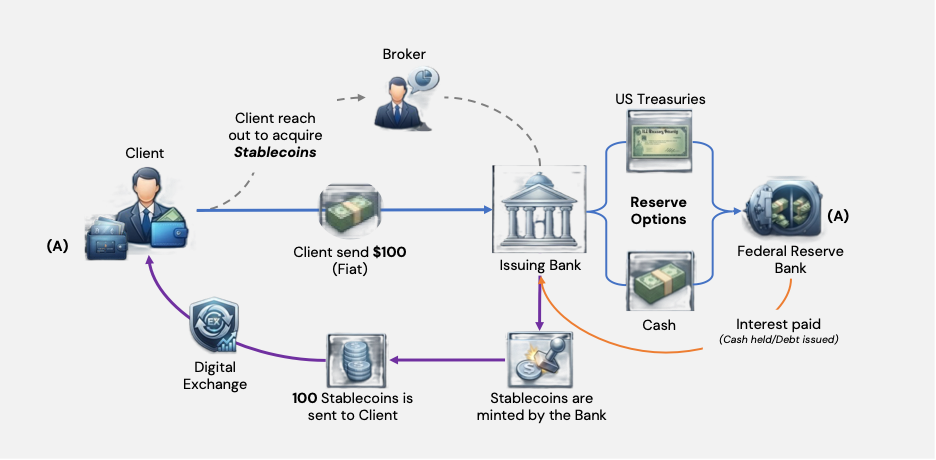
It is important to note that, unlike a bank deposit, a stablecoin is typically held in a digital wallet, either self-custodied by the individual or held on their behalf by a custodian, exchange or app. This is a meaningful structural difference from a bank account: since it lives outside the traditional deposit and lending system, its wider adoption could have meaningful implications for the deposit base banks rely upon to fund lending.
Common Use Cases
Once issued, stablecoins function as a digital bearer instrument that can move on a blockchain network nearly instantly, 24/7, without needing a traditional bank intermediary to clear the transaction. Common use cases include:
- Trading and settlement, stablecoins are widely used within cryptocurrency markets as a stable unit of account for trading other digital assets, avoiding constant conversion back to fiat currency
- Cross-border payments and remittances, because blockchain transfers settle faster and often more cheaply than traditional wire transfers or correspondent banking, stablecoins are increasingly used to move dollars internationally
- Payments and payroll, businesses have begun using stablecoins for supply-chain payments, cross-border payroll and merchant settlement, particularly where speed or cost is a priority
- Holding digital dollars, in markets with limited access to stable local currencies or US dollar banking, individuals sometimes hold stablecoins as a proxy for dollar savings
What the GENIUS Act Does
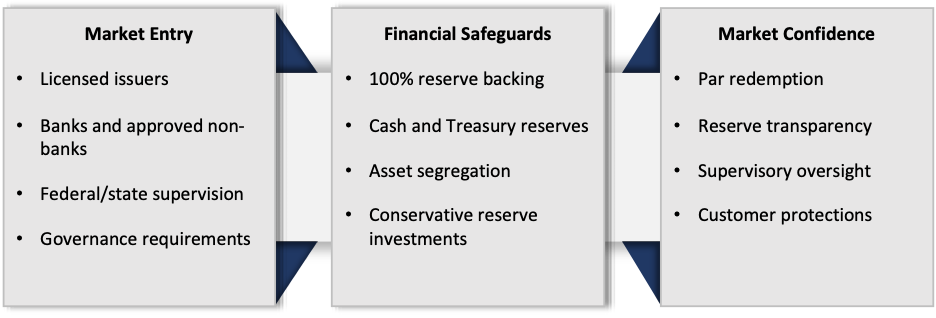
The GENIUS Act establishes a licensing and supervisory regime for permitted issuers of payment stablecoins, digital tokens pegged 1:1 to a fiat currency or similar reserve asset and intended for use in payments.
The Core Tension for Smaller Banks
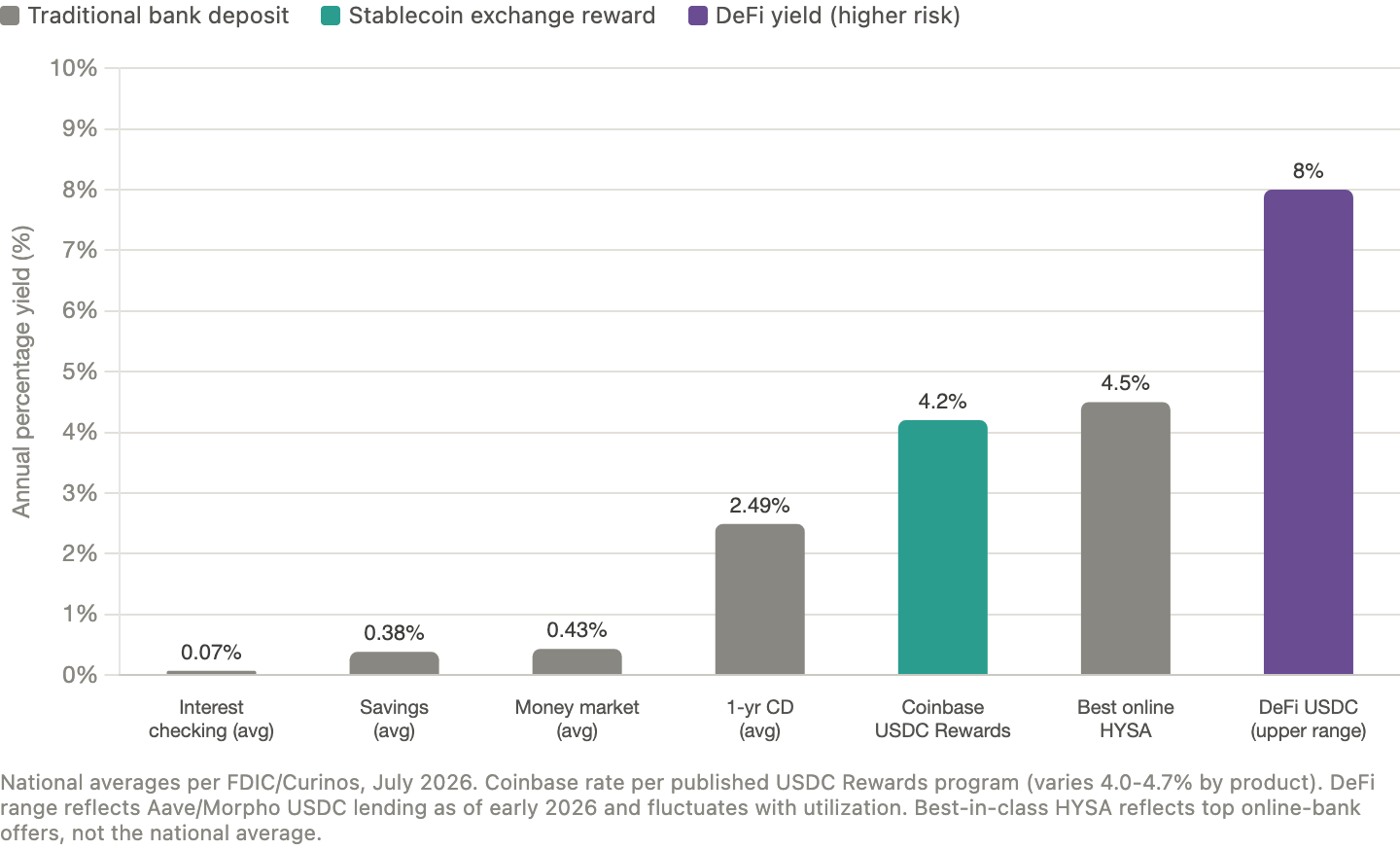
The GENIUS Act was partly designed with a built-in safeguard against deposit flight: since issuers cannot pay yield, the theory goes, a stablecoin has little advantage over an interest-bearing deposit account. In practice, community bankers and industry groups have identified a gap in that logic. The prohibition applies only to the issuer, not to the wallets, exchanges or affiliates that hold stablecoins on customers' behalf. In January 2026, the American Bankers Association's Community Bankers Council, representing more than 200 community bank leaders, sent a letter to the Senate arguing that exchanges such as Coinbase and Kraken were offering reward programmes on stablecoin balances that function as indirect yield, and asked Congress to close that gap.1 This has turned deposit flight from a theoretical concern into an actively studied risk.
While the strategic implications vary by size, community, regional and midsize banks all face increasing pressure to adapt to a stablecoin-enabled financial system. Community banks are unlikely to compete through standalone stablecoin issuance and are instead expected to rely on partnerships or consortium models to preserve deposits and maintain lending capacity. Regional banks are likely to face the greatest competitive squeeze, requiring investment in real-time payments, blockchain connectivity and digital asset capabilities to remain relevant in commercial banking and treasury services. Midsize and growth-stage banks have a narrower window to establish themselves as early adopters, using stablecoins or tokenised deposits to strengthen customer relationships before larger competitors and fintechs capture market share.
Across all segments, the Act shifts the strategic focus from whether banks should engage with digital money to how quickly they can modernise their infrastructure and business models while protecting their funding base.
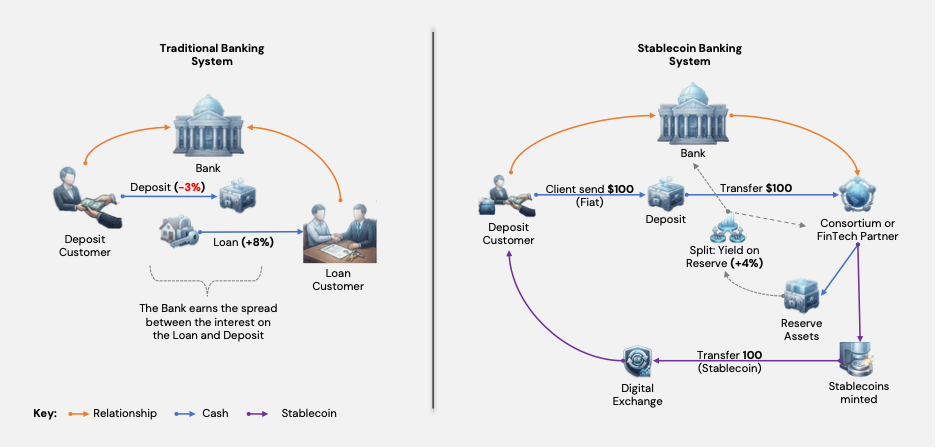
Note: the current concerns centre on a reduced current account as a result of flight to stablecoin-enabled institutions. However, if exchange rewards programmes remain, this could widen to other deposit products, complicating the lending business for these banks since cash reserves (deposits to a Fed master account) are non-rehypothecated.
Participation Pathways
For a community or regional bank deciding how to engage with the stablecoin market, the options range considerably in cost, risk and time-to-market. Our perspective is that for this group, the two options below offer the easiest, lowest-cost entry point:
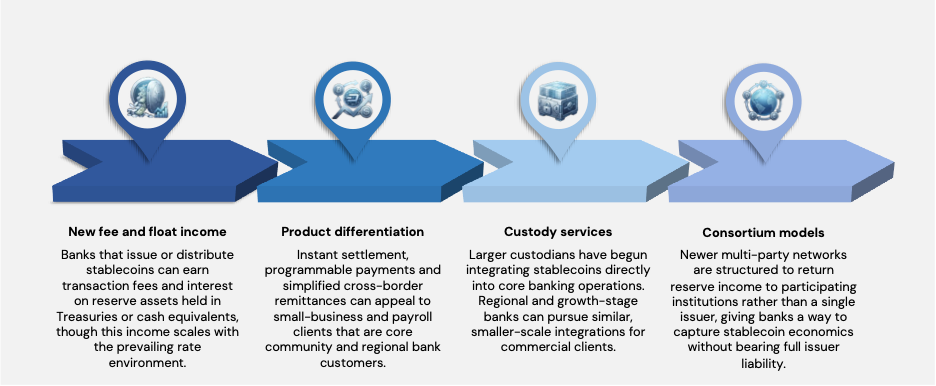
- Join an existing multi-bank consortium (easiest, lowest-cost entry point), this avoids building blockchain infrastructure or absorbing full issuer liability alone. Concrete examples emerging in 2026 include correspondent-bank consortiums such as SouthState's Correspondent Division, which is organising smaller institutions to pool resources rather than build stablecoin programmes independently, and large multi-party networks such as Open USD and the Paxos-led Global Dollar Network (USDG).4,6 These structures are designed so participating institutions share in reserve income and governance rather than having economics flow entirely to a single issuer
- Partner with a fintech or core banking provider, a bank can white-label stablecoin-enabled features such as faster payments, treasury tools and remittances through its existing core provider or a fintech partner, without building the underlying technology, while retaining the customer relationship. Bankers themselves have pointed to this as a more realistic path than solo issuance.2
Reserve Asset Yields in Historical Context
Because the Act requires 1:1 reserve backing in cash or short-term Treasuries and bars issuers from paying yield to token holders, the entire spread between what reserves earn and 0% becomes the issuer's float income.

From our perspective, two considerations stand out for treasury teams evaluating the economics of stablecoin issuance:
- Reserve income is rate-cycle dependent, not structural, at today's roughly 3.8% short-term yield, $1 billion in reserves generates on the order of $38 million a year in float income with no offsetting interest expense. During the extended near-zero stretches shown above, after the 2008 financial crisis and again in 2020–21, that same $1 billion would have generated close to nothing, which materially changes the business case for issuing a stablecoin at all
- The current environment, at roughly 3.8%, sits in the middle of the historical range, well above the post-2008 and pandemic-era lows but far below the 1981 Volcker-era peak of roughly 14%. Banks modelling multi-year stablecoin economics should stress-test reserve income against both tails, not just current rates
One caution on the regulatory direction: the FDIC's June 2026 proposed rule implementing GENIUS Act requirements for FDIC-supervised issuers would clarify that deposits held as reserves backing payment stablecoins are not passed through as insured to stablecoin holders themselves.5 Banks should not assume deposit-insurance treatment will extend to stablecoin balances as a source of competitive relief; if anything, current rulemaking is moving to make that distinction explicit.
For most community and regional banks, joining a consortium or partnering through an existing core or fintech relationship is the realistic near-term entry point, it provides stablecoin-enabled products and a share of reserve economics without the capital and infrastructure burden of solo issuance.
Our Perspective
The GENIUS Act gives community, regional and midsize banks a legal on-ramp into the stablecoin market that did not exist before, but it does not equalise the competitive playing field. The law's yield restriction was designed to protect bank deposits, yet a gap in how that restriction applies to exchanges and affiliates means smaller banks may still face real deposit-flight pressure. We believe institutions that begin evaluating payment infrastructure, tokenised deposits and collaborative issuance models now will be better positioned as the regulatory framework matures.