

For most of the last decade, deposit behavioural models sat quietly in the background of bank balance sheet management. Rates were low, deposits were sticky and the assumptions baked into non-maturity deposit (NMD) models, stable betas, long effective durations and gentle decay curves, went largely unchallenged. Between February 2022 and July 2023, the Federal Reserve raised the fed funds rate by 525 basis points in just 17 months, one of the fastest tightening cycles in decades, and the subsequent cutting cycle, alongside a structural rewiring of how customers manage cash, has exposed just how fragile many legacy models were.1 Banks that treated deposit modelling as a "set and review annually" exercise are now finding that the ground has moved beneath them.
This article looks at why deposit behaviour has changed, where legacy models are breaking down and what banks need to do differently to keep their asset-liability management (ALM), liquidity and pricing frameworks fit for purpose.
Why Deposit Behaviour Has Changed
Rate Sensitivity Has Outpaced What Betas Predicted
Deposit betas, the proportion of a rate change passed through to depositors, were historically calibrated on data from a near-zero rate environment where customers had little incentive to move money. As rates rose sharply, betas moved further and faster than many historical models implied. Research from the Federal Reserve Bank of New York found that deposit rates and betas continued climbing through the 2022–23 hiking cycle without ever catching up to the pace of the fed funds rate.2 Analysis of the top 30 US banks found that by early 2023, almost half had cumulative deposit betas that had already exceeded the levels seen over the entire 2015–19 hiking cycle.
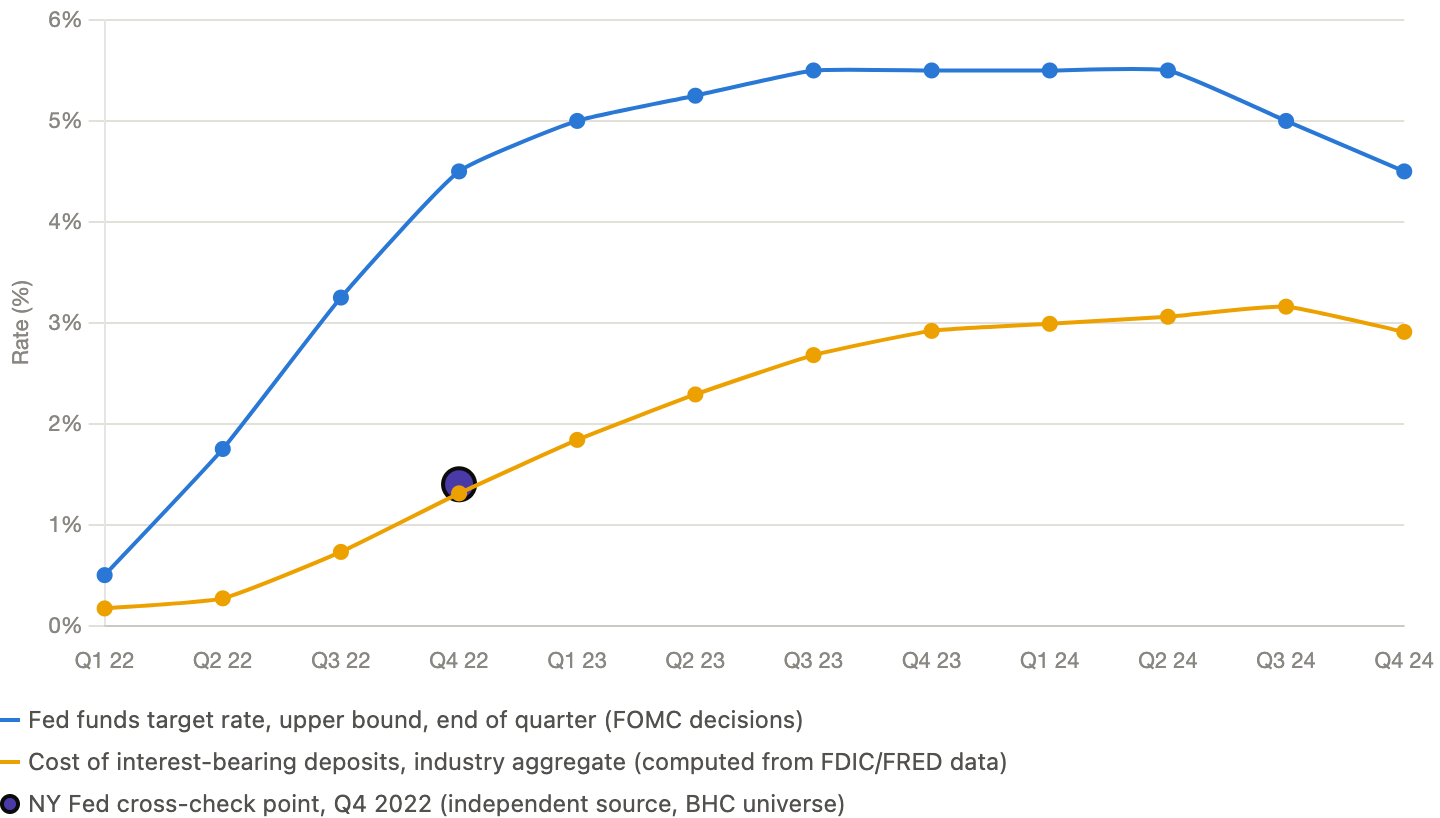
The effect was not confined to the US: euro area data show that between June 2022 and March 2023, term deposit rates rose by roughly 2.44 percentage points while overnight deposit rates increased by only about 25 basis points, as corporate depositors shifted balances from sticky overnight accounts into more rate-sensitive term products.3 Academic work has gone further, arguing that beta itself should be modelled as a function of the deposit outflows a bank experiences rather than treated as fixed.2,3,4
Digital Switching Has Collapsed the Friction That Made Deposits Sticky
A large part of the value in a stable deposit base has always come from inertia, the hassle of moving money. That friction has been eroding for years. Research into deposit-sensitive behaviour suggests customers who bank primarily through digital channels tend to be more sophisticated and rate-sensitive than those who transact mainly in branches. Models built on branch-era assumptions about stickiness no longer hold, particularly for digitally engaged customers.4
Cash Is No Longer "Parked", It Is Actively Managed
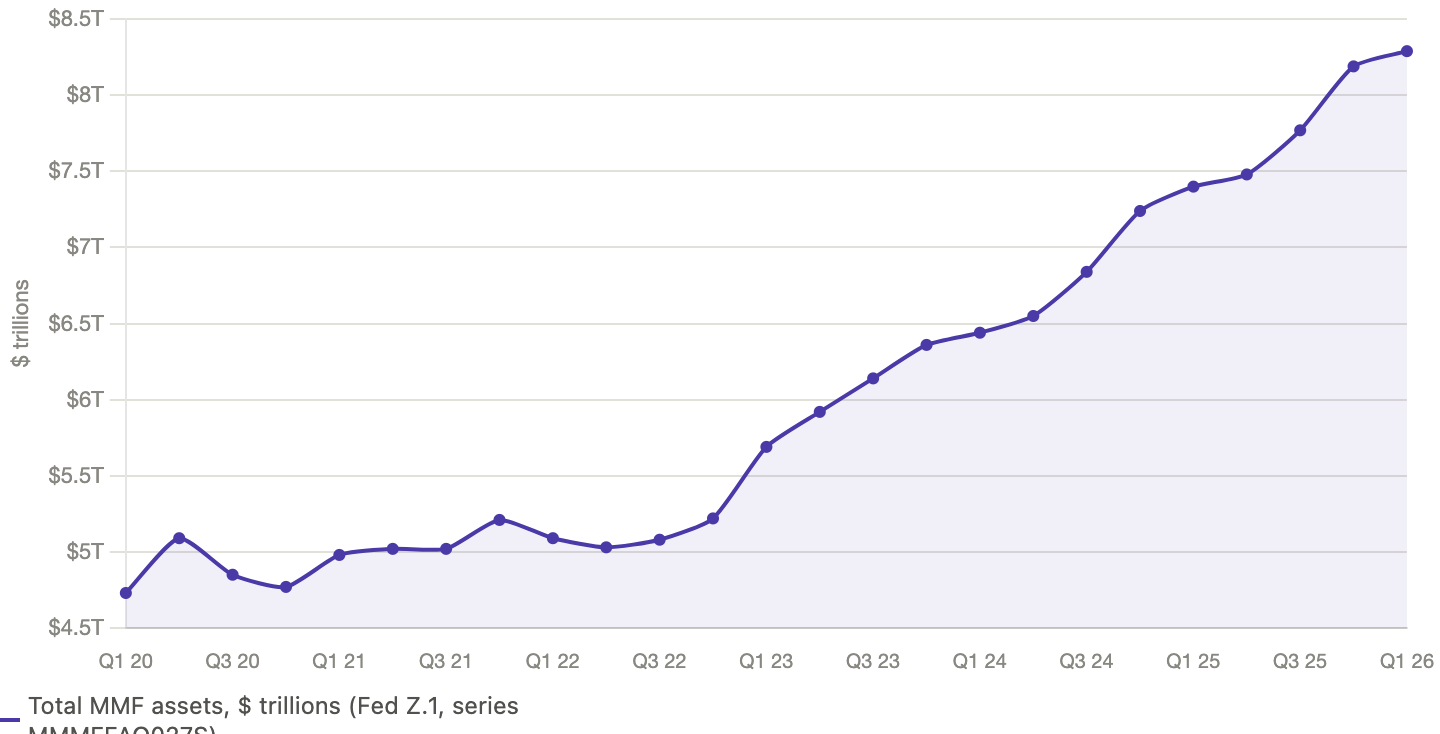
Cash-management alternatives have grown dramatically. US money market funds took in a record $1.2 trillion in 2023, the largest annual inflow on record, pushing total assets to $6.4 trillion, with regional-bank deposit concerns cited as one factor drawing in early-year flows. That growth continued: MMF assets reached roughly $6.9 trillion by the third quarter of 2024 and hit a record $8 trillion by early 2026.5 Treasurers, and increasingly retail customers, now treat deposits as one leg of an actively managed cash portfolio rather than a passive holding.
Concentration and Correlation Risks Are More Visible
The March 2023 collapse of Silicon Valley Bank was a sharp reminder that concentrated, largely uninsured deposit bases can move in a correlated, near-instantaneous fashion under stress. Customers withdrew $42 billion, nearly a quarter of the bank's total deposits, in a single day, with the failure unfolding in under 48 hours. Academic research analysing 5.4 million bank-related tweets found that social media conversation intensity predicted hourly stock-price losses during the run and concluded that rapid online communication materially raises bank-run risk, particularly where deposits are concentrated and uninsured.10 Conventional behavioural models, built on average historical decay patterns, were not designed to capture withdrawal events of this speed and correlation.
Product Innovation Is Outpacing Model Coverage
Tiered savings products, promotional rate accounts and hybrid demand/term structures blur the line between "core" and "non-core" deposits. Regulators define core deposits as those that history shows are highly likely to remain undrawn and unlikely to reprice even under significant rate changes, with everything else treated as non-core. Many legacy models still classify deposits using categories designed for a simpler product set than banks now offer.
Where Legacy Models Are Falling Short
- Static segmentation, many banks still segment deposits by product type and legal entity rather than by behavioural drivers such as rate sensitivity, digital engagement or balance concentration
- Backward-looking calibration, models calibrated purely on historical time series struggle when the current environment has no close historical analogue, a point regulators have increasingly pressed banks on
- Point-in-time betas and effective duration, treating beta and duration as fixed parameters ignores the effects of rate cycle and deposit outflows
- Thin tail-risk coverage, standard behavioural models are built for "normal" conditions and are rarely stress-tested against fast correlated withdrawal scenarios of the kind seen in 2023
- Weak feedback loops between pricing, treasury and risk, deposit pricing decisions are often made with limited real-time input from the models meant to describe how customers will respond
What Banks Should Be Doing
Move to Dynamic Conditional Behavioural Models
Betas, decay rates and effective duration should be modelled as functions of the current rate level, the pace and direction of rate change, competitive pricing and customer segment, not as fixed constants. This reflects an emerging strand of research proposing that deposit beta itself rises endogenously with deposit outflows rather than remaining constant through the cycle. Regulators including the EBA have been refining guidance on non-maturity deposit behavioural assumptions, underscoring that supervisors expect modelling practice to keep evolving.4,7
Segment by Behaviour Rather Than Just Product
Effective segmentation increasingly needs to combine product type with behavioural and demographic drivers, digital engagement level, balance concentration, insured versus uninsured status and channel of acquisition. Federal Reserve Bank of Kansas City data on community banking organisations confirms that cumulative deposit betas (46.9% in aggregate as of Q1 2024) were measurably higher among banks with branch presence in metropolitan markets, evidence that geography, not just deposit product type, shapes rate sensitivity.8
Shorten the Model Recalibration Cycle
Given how quickly betas moved through 2022–2024, continuing to climb even after the pace of rate rises slowed, annual or semi-annual recalibration is no longer sufficient. Leading banks are moving toward quarterly or monthly refreshes of key parameters, supported by automated data pipelines with a lighter-touch governance track for parameter updates versus full model redevelopment.
Build Genuine Stress and Reverse-Stress Testing Into the Core Framework
Behavioural assumptions should be explicitly stressed for fast, correlated, digitally-enabled outflows, the kind of event that saw a quarter of SVB's deposit base leave within a day and that researchers have linked directly to the speed of social media-driven coordination among depositors.10 Reverse stress testing should feed directly into contingency funding plans rather than sit as a separate exercise.
Integrate Deposit Modelling With Pricing and Treasury Decision-Making
Behavioural insights should feed directly into deposit pricing strategy and funds transfer pricing (FTP), with pricing and competitor data feeding back into the models in near real time, given how sensitive outflows and repricing have become to the gap between bank deposit rates and alternatives such as money market funds.
Strengthen Governance Without Freezing Agility
Faster recalibration does not mean weaker governance, it means governance designed for higher-frequency change, facilitated by pre-agreed tolerance bands that trigger automatic review, clear escalation paths for material parameter shifts and model risk frameworks that distinguish routine recalibration from structural redevelopment. This sits alongside continued regulatory scrutiny of areas such as the five-year repricing maturity cap on non-maturity deposits under both Basel and EBA rules.7,9
Invest in Data Infrastructure
Much of this is ultimately a data problem. Granular, timestamped, customer-level deposit and transaction data, linked to digital engagement metrics and external rate benchmarks, is the foundation for any of the above. Banks still reliant on monthly, aggregated balance snapshots will struggle to build genuinely responsive models regardless of the modelling technique chosen.
The Bottom Line
The deposit base that underpinned bank funding for the past decade was, in many cases, more behaviourally fragile than models suggested, a vulnerability the 2023 stress events exposed. A historically fast rate-hiking cycle, rising deposit betas that outpaced legacy assumptions, the growth of easily accessible cash alternatives and the demonstrated speed at which digitally coordinated withdrawals can move have all permanently changed the risk picture for depositor behaviour.
Banks that treat behavioural modelling as a living, frequently recalibrated discipline, tightly integrated with pricing, treasury and stress testing, will be far better positioned to manage margin, liquidity and funding risk through the next phase of the rate cycle than those still relying on assumptions inherited from the post-financial-crisis era.