

The CBLR framework gives qualifying community banks a simplified alternative to traditional risk-based capital rules. Established under the Economic Growth, Regulatory Relief and Consumer Protection Act of 2018 and implemented by the OCC, the Federal Reserve and the FDIC effective January 1, 2020, it lets an eligible bank replace several risk-based capital calculations with one number: a leverage ratio. Stay above the required threshold and the bank is automatically deemed "well capitalised", no risk-weighting required.1,7
To qualify, a bank generally needs: total consolidated assets under $10 billion, off-balance-sheet exposures of 25% of total assets or less, trading assets and liabilities of 5% of total assets or less, and a leverage ratio above the required minimum. Effective July 1, 2026, that minimum drops from 9% to 8%.3,7
Opting in is elective and a bank can opt back out at any time. That makes this fundamentally a decision each qualifying bank has to make for itself, and the right answer depends heavily on the bank's own balance sheet. This article walks through the mechanics of both frameworks side by side, then works through what a bank should actually be weighing before making the switch.
How the Two Frameworks Calculate Capital
Traditional risk-based capital requires a bank to hold capital against risk-weighted assets (RWA), each asset category gets multiplied by a risk weight reflecting how likely it is to lose value, before the ratio is calculated. A bank must clear four separate minimums simultaneously:
The CBLR replaces all four of those ratios with one, calculated against total assets rather than risk-weighted assets:
No risk-weighting, no distinguishing a Treasury bond from a commercial loan, every dollar of assets counts the same.
Difference in the Two Frameworks
Consider a conservatively positioned $100 million community bank holding $9 million of Tier 1 capital (a 9% raw leverage position) and $9.5 million of total capital (adding $0.5 million of Tier 2 items like allowance for credit losses).
| Asset Category | Amount | Risk Weight | Risk-Weighted Assets |
|---|---|---|---|
| Cash & U.S. Treasuries | $60M | 0% | $0M |
| Agency MBS | $20M | 20% | $4M |
| Residential mortgages (1st lien) | $15M | 50% | $7.5M |
| Commercial loans | $5M | 100% | $5M |
| Total | $100M | — | $16.5M |
Under the traditional risk-based framework, this bank's ratios are calculated against $16.5 million of RWA:
| Ratio | Actual | Required | Excess Capital |
|---|---|---|---|
| CET1 | 9 ÷ 16.5 = 54.5% | 7.0% | $7.8M |
| Tier 1 | 9 ÷ 16.5 = 54.5% | 8.5% | $7.6M |
| Total Capital | 9.5 ÷ 16.5 = 57.6% | 10.5% | $7.8M |
This bank is dramatically over-capitalised by risk-based standards, its conservative asset mix means very little capital is actually required against it.
Under the CBLR, the same $9 million of Tier 1 capital is measured against the full $100 million of assets:
| Ratio | Actual | Required | Excess Capital |
|---|---|---|---|
| CBLR | 9 ÷ 100 = 9.0% | 8.0% | $1.0M |
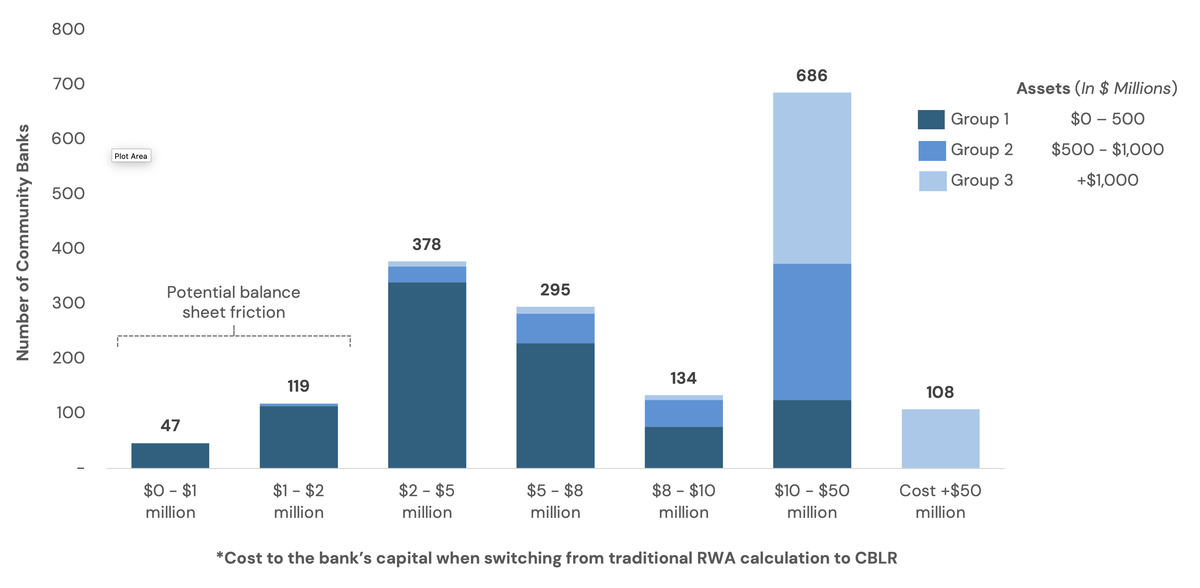
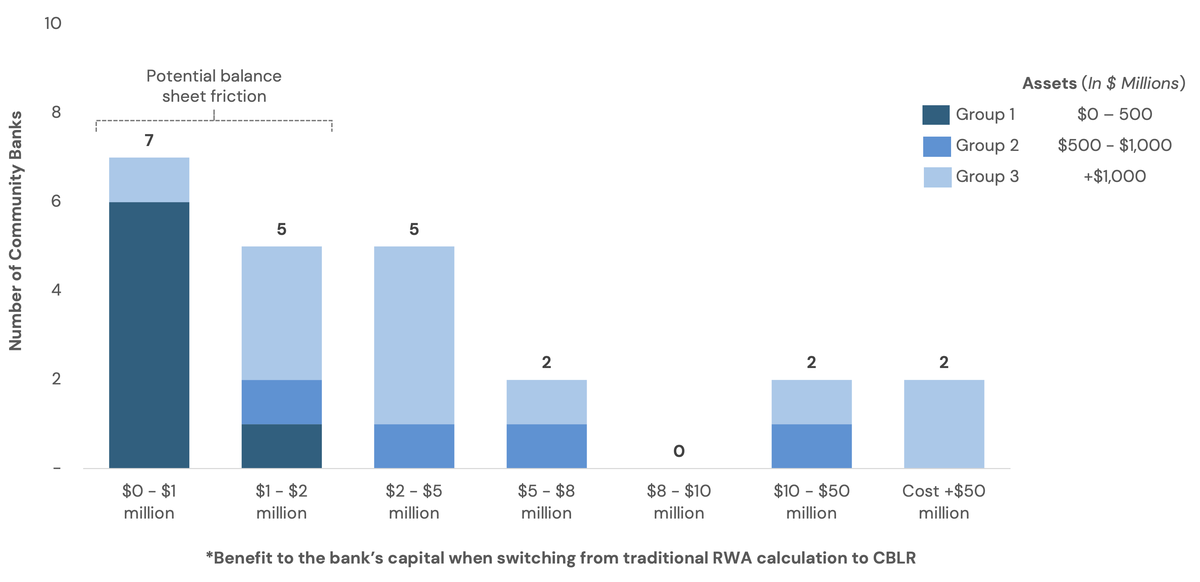
Same bank, same balance sheet, but its capital cushion looks completely different depending on the lens. Under risk-based rules it has roughly $7.6–$7.8 million of excess capital; under CBLR, only $1.0 million. That gap is the risk-sensitivity the CBLR gives up in exchange for simplicity.
Now consider growth: suppose this bank wants to add $50 million more in U.S. Treasuries, a very safe way to deploy excess deposits.
- Under risk-based rules, Treasuries carry a 0% risk weight, so RWA doesn't change. The bank's risk-based ratios are essentially unaffected, it can add this growth with no new capital.
- Under the CBLR, total assets rise to $150M. The same $9M of Tier 1 capital now produces a ratio of 9 ÷ 150 = 6.0%, below the 8% requirement. To stay CBLR-compliant, the bank would need to raise its Tier 1 capital to at least $12M (8% × $150M), a $3M capital raise, just to support growth in the safest assets on its balance sheet.
This is the mechanism behind two of the biggest reasons a bank might stay out of the CBLR.
What Community Banks Should Weigh Before Opting In
1. How Risk-Sensitive Is Your Balance Sheet?
If a meaningful share of your assets are low-risk-weight (Treasuries, agency securities, well-collateralised first-lien mortgages), the risk-based framework may require substantially less capital than the CBLR does, as shown above. A bank in this position gives up real capital efficiency by opting into CBLR, it will look "less well capitalised" on paper, relative to what risk-based rules would actually require of it.8
We believe the higher the percentage of your assets that carry a risk weight below 100%, the more capital efficiency you are likely to be leaving on the table by switching to CBLR.
2. What Does Your Growth Plan Look Like?
Because the CBLR treats every dollar of assets the same, growth in low-risk assets is "expensive" in leverage-ratio terms even though it is nearly free under risk-based rules, as the Treasuries example illustrates. A bank planning to grow primarily through low-risk-weight assets should model out how that growth erodes its CBLR ratio over time, and whether it is prepared to raise capital to keep pace.8
From our perspective, when banks are forecasting growth it should be over a 2–3 year period with specific focus on what risk weights those assets carry and whether they would be better off under the CBLR or traditional capital ratio rules.
3. How Much Buffer Do You Have Above the Threshold?
The CBLR is a single number with no redundancy, unlike the four-ratio risk-based system, there is nowhere else to "pass" if this one ratio dips. A large deposit inflow parked in cash right before quarter-end, a swing in unrealised securities losses or a run of credit losses can move the ratio quickly, since it is calculated against raw asset size rather than risk-weighted size. A bank running close to the 8% line has less room for error even with the extended four-quarter grace period introduced in 2026.3,6
We think banks should forecast their balance sheet out over a 2–3 year period to get a sense of how far above 8% they sit today versus how volatile that number would have been over the next two to three years.
4. What Is the Cost of Switching?
A bank that has already built risk-weighting into its reporting systems, trained staff around it and established examiner familiarity with it may find limited marginal benefit in phasing that infrastructure out, particularly if compliance burden is not currently a pain point. The reporting relief CBLR offers has to outweigh the one-time cost and disruption of the transition. Note that the reverse is also true: a bank currently on CBLR that wants to opt out later faces the same switching cost in reverse.
We know there are many nuances when it comes to managing a bank's balance sheet, and it is our view that management should on an ongoing basis analyse this decision taking a long-term view of the balance sheet to ensure the bank's capital is optimised appropriately.
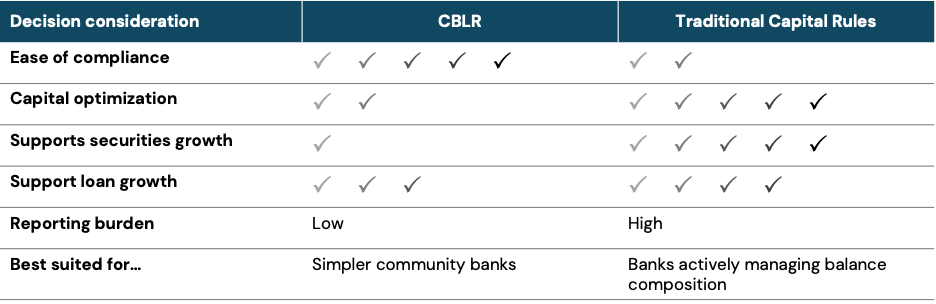
At a Glance: Pros and Cons
Key Regulatory Updates in 2026
Adoption of the CBLR has lagged expectations since its 2020 launch. Under the original 9% threshold, 3,426 community banking organisations qualified, but only about 47% opted in, a rate that has held roughly flat for six years.2,3 To address that, the OCC, Federal Reserve and FDIC finalised a rule effective July 1, 2026 that:
- Lowers the leverage ratio requirement from 9% to 8%, the statutory floor. Regulators estimate this expands the eligible population by 477 institutions (a 14% increase), bringing total eligibility to roughly 95% of all community banking organisations.3
- Extends the grace period from two quarters to four (capped at eight quarters in any five-year period) for banks that temporarily fall out of compliance, provided the leverage ratio stays above 7%.3,6
These changes directly target two of the four decision factors above, they widen the buffer and soften the consequences of a temporary dip. They do not change the underlying risk-sensitivity or growth-flexibility trade-offs at all. Tellingly, the agencies' own forecast expects adoption to rise only to about 2,039 institutions, roughly half of the newly expanded eligible pool, which suggests regulators recognise that a meaningful share of eligible banks will still find risk-based capital the better fit.3
Bottom Line
Before opting in, a community bank should run its own numbers: calculate its risk-weighted assets, compare its ratios under both frameworks and model how planned growth would affect its CBLR ratio specifically. Banks with loan-heavy balance sheets and limited appetite for tracking four ratios tend to gain the most from switching. Banks with a lot of low-risk-weight assets, plans to grow in that direction or a leverage ratio sitting close to the 8% line have real reasons to stay on risk-based reporting, or at least model the trade-off carefully before switching.
This is not a decision to make from a simplicity narrative alone, it is a capital-efficiency decision as much as a compliance-burden one and the two do not always point the same way. A side-by-side ratio comparison like the one above, run with the bank's actual balance sheet and growth plans, is the right starting point, ideally alongside the bank's auditor or regulatory advisor.